
Icarus
by SASAKI Gakuto (b. 1983)
Heisei period, 2017
Dry lacquer form, kanshitsu, with innovative lacquer finishes, kawarinuri
24.5 × 18 × 13 (h) cm.
Sealed. Sealed wrapping cloth.
Signed and sealed tomobako
Price: £7800
About
I first saw the work of Sasaki-san in 2011 at the Wajima Lacquer Art Museum’s annual hosting of graduation work from lacquer schools across Japan. It was fresh, original and intriguing, and I determined to track him down. I found him in Tokyo, where he had been a student at the Tokyo University of the Arts, Tokyo Gedai. In 2012 I first showed his work in the West, and I am delighted to again have two pieces by him.
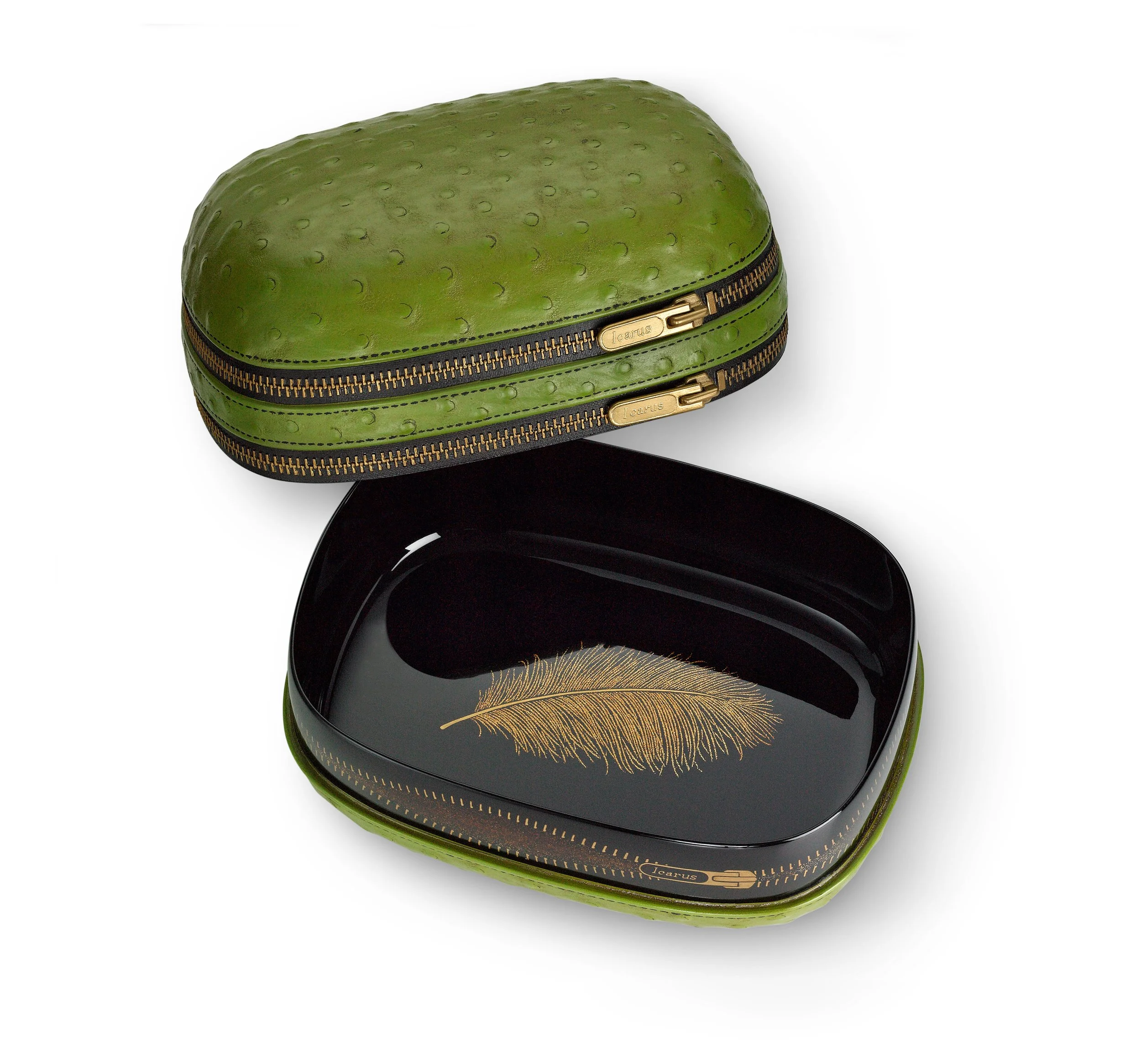
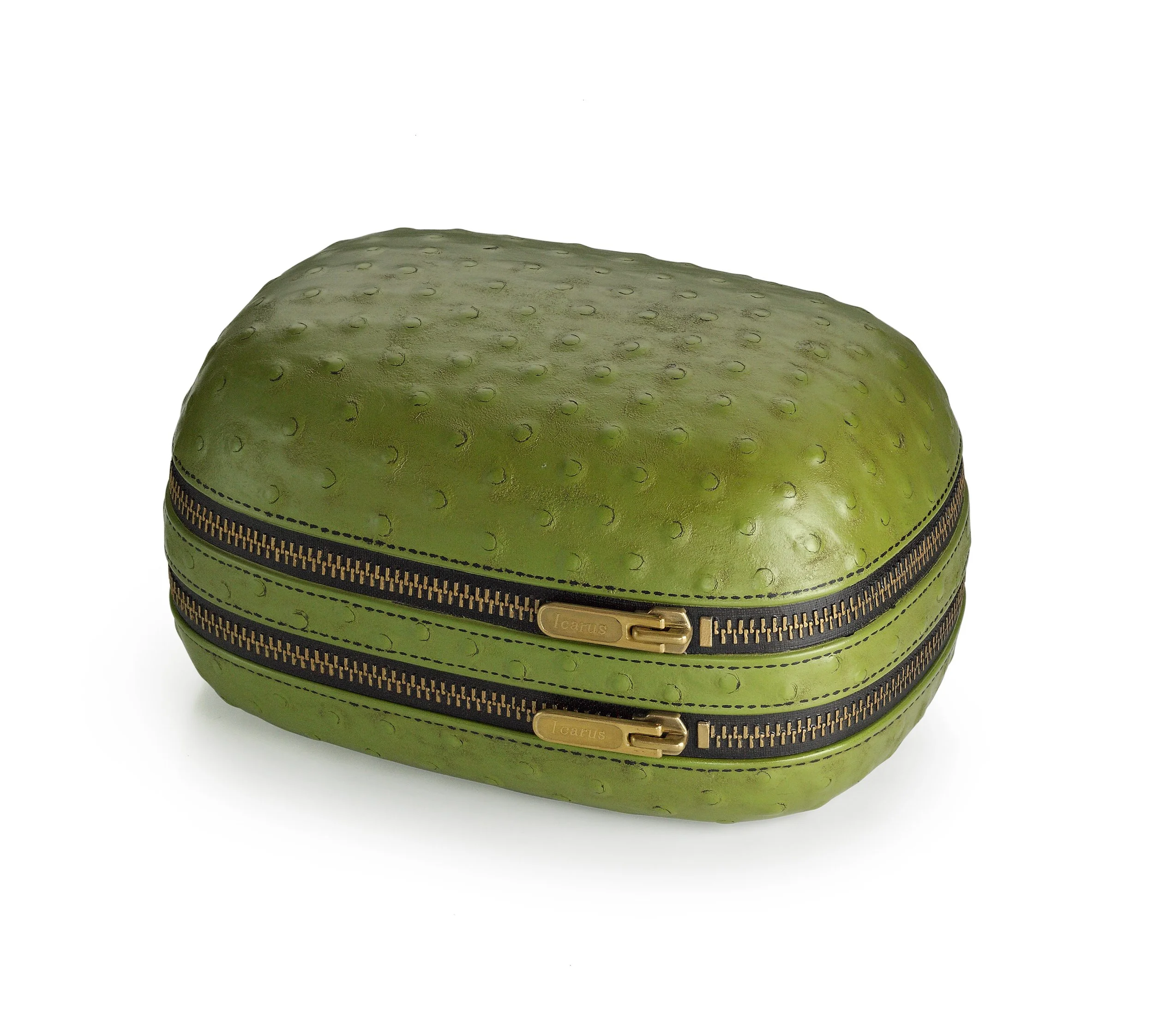
ICARUS is a work inspired by the Greek myth of a man who, despite warnings, with wings constructed of feathers and wax, flew too close to the sun, causing the wax to melt. He drowned in the sea below. Sasaki’s work draws on this fable. The box appears to be fastened with two zips and to be covered in green ostrich skin. This structure is a typical Sasaki optical illusion, trompe-l’oeil, since all is made of imitative lacquer. The inspiration behind the choice of ostrich stems from the now-accepted fact that ostriches once flew, but lost that ability during the evolutionary period. Opening the box reveals a solitary ostrich feather in gold makie on the base – a fall from grace.
The techniques employed in this box – particularly the zips – have become Sasaki’s unique motifs. The zips are painstakingly formed using individually cast lacquer teeth that are inlaid one by one into black, lacquer-soaked cloth. The zip tags, displaying the work’s name, are flexible and finished in gold makie. The box’s riser, revealed when the lid is lifted, displays an opened zip.
Optical illusion has a long history in Japanese art, particularly through lacquer’s ability to imitate a range of material and surfaces – from wood and ceramic to rusting metal. The reaction it invokes – aware (awaa-ray) – a feeling of playfulness, surprise and amusement – has long been central to Japanese art.
Sasaki now teaches in the urushi school at the Tokyo Gedai. His commercial production is very low, exhibiting only every 4–5 years.